


No. The proxy acts as a standard smart-contract caller and routes through your existing DEX router, so your core AMM needs zero modifications and no re-audit. Integration is deployed as a proxy layer plus a frontend SDK (or via API).
Public EVMs are transparent by design. For a fund or desk, that transparency is a structural blocker: balances, positions, and trade timing are visible on-chain the moment they act. That exposes alpha, invites copy-trading, and turns every hedge into a public signal.
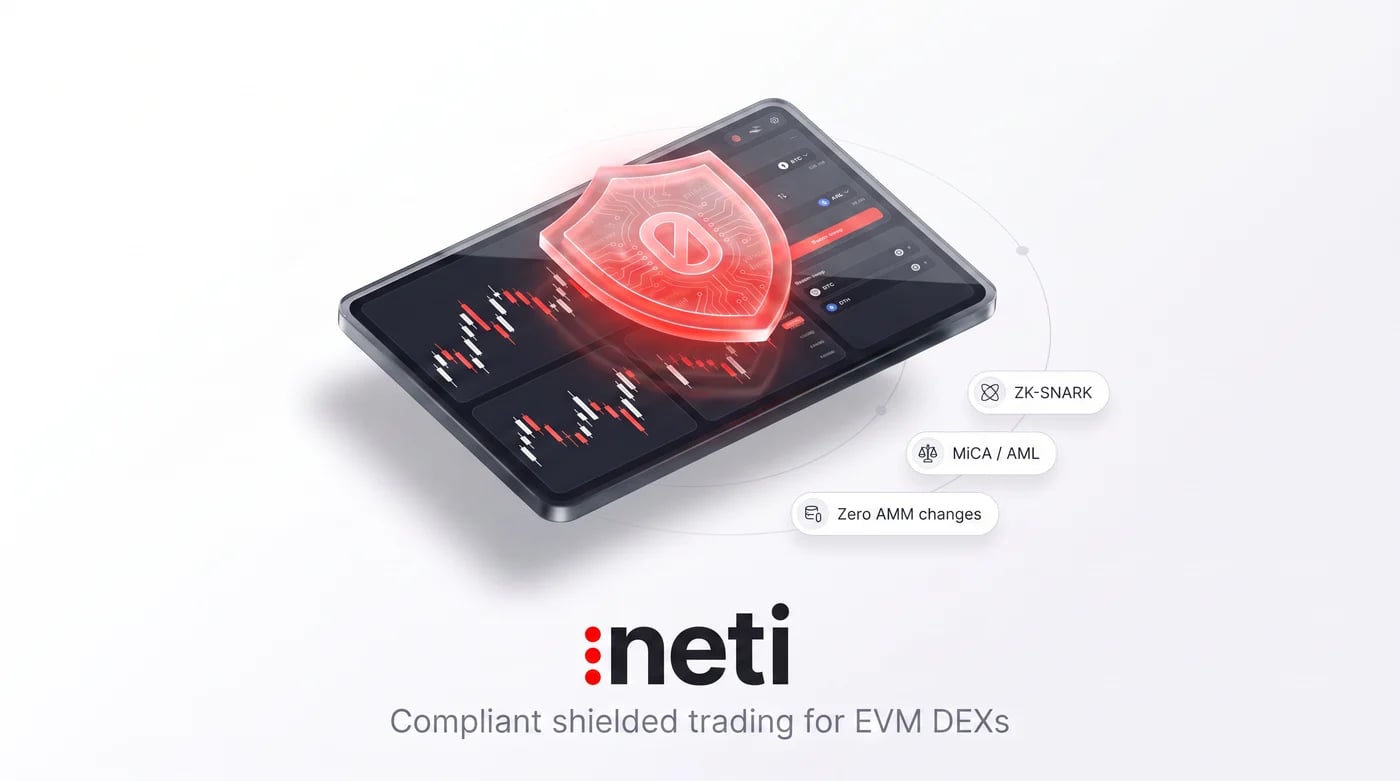
Neti's Shielded Trading Proxy is a non-invasive ZK-SNARK privacy layer that sits in front of your existing DEX. Institutions execute private trades through your existing public AMM liquidity, no new chain, no shielded pool to bootstrap, no liquidity fragmentation. Confidential data can be selectively revealed to a compliance officer or auditor through a multisig view key, so privacy and MiCA/AML auditability coexist.
| Approach | Separate chain/migration | Privacy tech | Private from operator | Regulator-ready (selective disclosure) | Touches core AMM |
|---|---|---|---|---|---|
| Neti Shielded Trading Proxy | No, layer on your existing EVM | Pure ZK-SNARK + selective disclosure | Yes | Yes, multisig view key | No |
| Ready ZK libraries (Railgun) | No (closest in architecture) | ZK, retail-user oriented | Partial | No clear compliance/view-key story | No |
| Privacy L2 (Aztec) | Yes, you move to their L2 | ZK (Noir) | N/A | Limited | N/A |
| FHE layer (Zama) | Confidentiality layer | FHE (flexible, slower today) | Varies | Emerging | Product-only |
| Private permissioned chain (ZKsync Prividium) | Yes, migrate to a separate chain | ZK proofs to L1 | No, operator sees all txns | Yes | N/A |
| Mixers (Tornado-style) | No | Anonymity set | Yes | No, breaks AML/MiCA | No |
This is for teams that operate on public chains and need privacy with compliance, not instead of it:

without forcing public exposure.

running an AMM or perpetual DEX on an L2

without abandoning compliance.

that pulls institutional capital onto your venue instead of a competitor's.
Four differences that matter to an engineer who's afraid of two things, breaking their audited core and breaking the law:
No. The proxy acts as a standard smart-contract caller and routes through your existing DEX router, so your core AMM needs zero modifications and no re-audit. Integration is deployed as a proxy layer plus a frontend SDK (or via API).
No. There are no separate shielded pools to bootstrap, private trades execute through your existing public AMM liquidity, so composability with the rest of DeFi is preserved.
Yes, by design. Transactions are private to the market but not anonymous: a compliance officer can use a multisig view key to selectively decrypt specific fund flows for CASP/AML auditors. It's built for "compliant with regulators — not hiding too much," not for evasion. (This is a technical architecture, not legal advice; your compliance team confirms fit for your jurisdiction.)
Mixers provide blanket anonymity and break AML/MiCA obligations, which rules them out for regulated entities. Neti's approach keeps trades private from the market while preserving selective, regulator-facing disclosure, privacy with auditability, not anonymity.
Railgun targets individual users and has no clear multisig-view-key compliance path; Aztec requires moving to a separate privacy L2. Neti adds privacy on the public chain you already use, keeps trades private even from the operator, and is built for institutions that need auditability.
The architecture uses client-side ZK proving and relayer-based execution to avoid the scaling bottlenecks seen in some existing ZK privacy tools. The right answer for your specific throughput is validated in a scoped PoC before any production commitment.
It removes the public pre-trade signal that most front-running depends on by shielding intent and execution. It is a privacy layer, not a blanket MEV-elimination guarantee; the exact protection profile is defined against your venue's design.
Shielded execution for institutional order flow on an existing EVM DEX, private balances and positions, existing liquidity, and selective disclosure for compliance — delivered as a PoC first, then hardened for production.
We partner with teams building blockchain infrastructure, payment systems, tokenization platforms, and protocol-based products. Our initial consultations focus on architecture, technical direction, delivery risks, and production readiness. If blockchain is the optimal path, we’ll help you define the most strategic next step.


We can walk your team through the architecture, privacy model, and integration logic behind the Shielded Trading Proxy, including ZK-SNARK proof generation, relayed execution, DEX router integration, and selective disclosure.
Neti adds a ZK‑SNARK privacy layer to your existing EVM DEX so institutional traders can shield balances, positions, and order flow, without touching your audited AMM and without breaking MiCA/AML.